Safe Homes for All Begin with Community Power
Joint statement by the International Federation of Settlements and Neighbourhood Centres (IFS) and the International Association for Community Development (IACD) for the 2026 International Day for the Eradication of Poverty
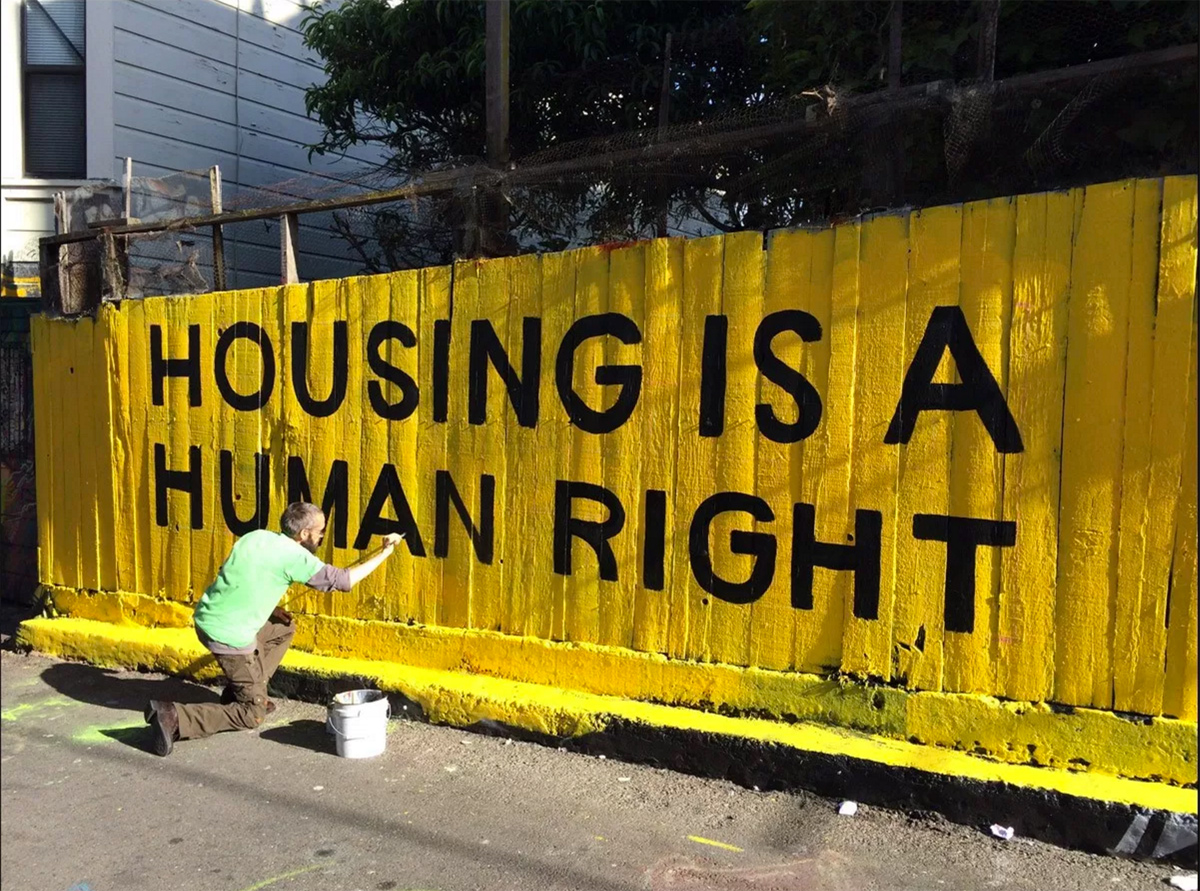
Mural by Christopher Statton and Megan Wilson, by Ponderosa Templeton licensed by CC BY 4.0
Safe Homes Are the Foundation of Dignity
A safe home is more than four walls and a roof. It is a place of safety and hope. It is where children can sleep without fear of eviction, families can recover from setbacks, and older adults can stay connected to people and places they know. Yet more than 2.8 billion people experience housing inadequacy, including 1.1 billion living in informal settlements.
On the International Day for the Eradication of Poverty, IFS and IACD call for urgent action under the 2026 theme, “Safe Homes for All”. Adequate housing and accommodation are essential to human dignity and other human rights. Governments cannot credibly commit to eradicating poverty without securing this right and sharing power with the communities affected by housing decisions.
Housing Insecurity is Structural and Intersectional
Housing insecurity is not the result of individual choices alone. It is shaped by systems that distribute land, resources and decision-making power unequally. When homes are treated as investment assets rather than social goods and when social protections fail, people are pushed into unsafe, overcrowded, or precarious conditions and blamed for circumstances beyond their control.
Housing insecurity also rarely travels alone. Illness, insecure work, caregiving responsibilities, disability, violence, discrimination and climate-related displacement can increase the risk of losing a home. Unstable housing then intensifies these pressures, disrupting education, health, employment and community participation. Rights that exist on paper become harder to exercise in practice.
Community workers across our networks see these connections every day. A family seeking food assistance may spend most of its income on rent, while repeated moves disrupt its children’s education. An inaccessible apartment may isolate an older adult or a person with disabilities. A woman escaping violence may be forced to choose between danger and homelessness.
A secure home does not solve every problem, but it provides a foundation for people to care for one another, pursue education and employment, participate in their communities and exercise their rights with dignity.
Communities are knowledge-holders and agents of change.
One contributor from Bangladesh to the global consultation for the 2026 theme stated, “Building a sustainable world requires shifting from charity to partnership”. This means recognizing people experiencing poverty not simply as beneficiaries but as knowledge holders and agents of change.
People living with housing insecurity know where systems fail. Community power means more than being heard: it is the collective capacity to set priorities, influence resources, and hold institutions accountable. Policies are more legitimate and effective when communities genuinely influence them, not when they are consulted after decisions are made.
Locally rooted organizations make participation and collective action possible
Meaningful participation grows from trust and relationships built over time.
Across our networks, locally rooted organizations develop affordable and supportive housing, prevent evictions, help residents maintain stable homes and advocate for fairer systems.
Through relationship-building, community education, participatory planning and organizing, practitioners help people move from facing problems individually to understanding and acting on them collectively.
Settlement Houses, Neighborhood Centers and community development organizations therefore provide the civic infrastructure through which residents build leadership and exercise collective voice.
Community-led action must not excuse governments from their responsibilities. Communities cannot overcome structural inequality through goodwill or resilience alone. Public institutions must share power and provide the resources that make sustained participation possible.
From Community Action to Systemic Change
The Doha Political Declaration, adopted by the UN General Assembly following the Second World Summit for Social Development in November 2025, reaffirms the right to an adequate standard of living, including safe, accessible and affordable housing. Fulfilling this commitment requires governments and institutions to change both what they fund and whose knowledge shapes their decisions.
IFS and IACD call on UN Member States, intergovernmental organisations, international financial institutions, funders and larger civil-society organisations to take three actions.
1. Adopt and resource community development and its local infrastructure
Governments and funders should recognise community development as a professional discipline and an essential approach to equitable social change. They should provide sustained, flexible core funding for skilled practitioners and locally rooted organisations, including the relationship-building, organizing and leadership development that short-term project grants rarely support.
Success should be measured not only by services delivered, but also by growth in community agency, collective capacity, influence over decisions and resources, as well as robustly resourced third sector community development infrastructure.
2. Finance housing as a public good and apply a climate-justice lens
Governments must place the right to adequate housing before financial returns. Public investment in affordable as well as social housing, social protection and essential services should be supported through progressive and gender-responsive equitable taxation. International financial and debt arrangements must not force cuts to housing, health, education and social development.
Climate finance should prioritize low-income communities and informal settlements facing the greatest risks from heat, flooding, fires and displacement. It should support community-led upgrading, resilient homes and essential services without imposing unaffordable costs on residents.
Green redevelopment must not drive rising rents or displacements, and communities must influence how adaptation, rebuilding or relocation proceeds.
3. Create formal pathways for communities to shape policy, budgets and implementation
People experiencing poverty and housing insecurity must have real influence over the decisions affecting them. Governments and institutions should establish accessible, well-resourced mechanisms through which residents and community-development practitioners influence priorities, policy design, budgets, implementation, and evaluation. Institutions should report publicly on how community participation has affected their decisions.
Change begins within communities, but it cannot end there. Local knowledge, leadership and collective action must shape the policies, institutions and resources that determine whether everyone can live in safety and dignity.
Statement Information
Issued: 17 October 2026
Jointly Issued By: The International Federation of Settlements and Neighbourhood Centres and the International Association for Community Development
Both IFS and IACD hold consultative status with the United Nations Economic and Social Council.
About the International Federation of Settlements and Neighbourhood Centres
The International Federation of Settlements and Neighbourhood Centres (IFS) is a global association that connects, strengthens and amplifies Settlement Houses and Neighbourhood Centres. Its 89 member organisations collectively reach nearly 11,000 centres across 23 countries and five continents. IFS supports these locally rooted institutions to build their capacity, learn across borders and bring community perspectives into regional and global forums.
About the International Association for Community Development
The International Association for Community Development (IACD) is a global, multidisciplinary network for community-development practitioners, educators, researchers, students, and organisations, with members in more than 70 countries. IACD promotes values-based community development through professional standards, learning, research, practice exchange and international advocacy.
Media Enquiries
International Federation of Settlements and Neighbourhood Centres
Christopher Hanway
IFS UN Representative
chanway@riissettlement.org
International Association for Community Development
Anna Clarke
Strategic Director
anna.clarke@iacdglobal.org